
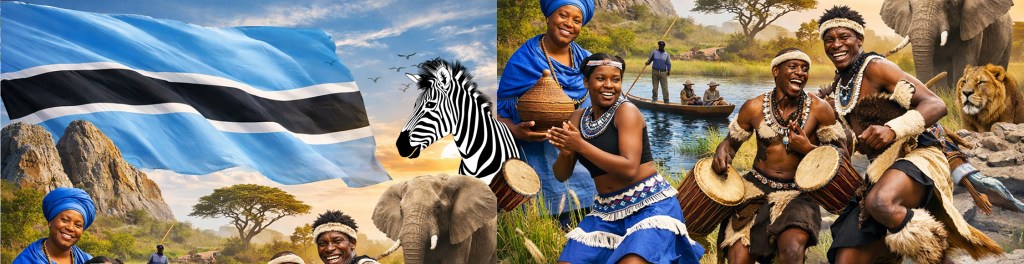
Location and Geography:
Botswana, a landlocked country in Southern Africa, borders South Africa, Namibia, Zimbabwe, and a short boundary with Zambia. Covering approximately 581,730 km², it is known for wide-open landscapes, low population density, and the Kalahari Desert. The country’s population is around 2.6 million in 2026. Often called the “Zebra Nation,” Botswana treasures its wildlife and natural heritage. The concept of Pula reflects both rain, vital in this semi-arid country, and the national currency, linking cultural values with economic stability. English is the official language, while Setswana is spoken by most of the population, which is organized into over 16 tribes.
Cities and Urban Centers:
Gaborone, the capital and largest city, serves as Botswana’s political, economic, and administrative hub, with a population of about 273,000. Francistown, historically a gold-mining town, has developed into a commercial hub in the north with around 103,000 residents. Other significant settlements include Maun, the gateway to the Okavango Delta; Molepolole; Serowe; Kanye; Selibe Phikwe; and Palapye. While Gaborone dominates the national economy, these towns act as regional centers for tourism, commerce, and transport.
Economy and Governance:
Botswana has one of Africa’s most stable economies, driven by responsible governance, infrastructure development, and education. Diamonds are the backbone of its economy, with Debswana, a partnership between the government and De Beers, playing a key role in national development. Since independence in 1966, Botswana has maintained a stable democracy, with a president as head of state and government, an elected parliament, and an independent judiciary. Political stability, transparency, and sound economic management have helped the country achieve middle-income status.
Tourism and Wildlife:
Botswana is renowned for eco-conscious tourism and diverse wildlife. The Okavango Delta, Chobe National Park, Moremi Game Reserve, and the Central Kalahari Game Reserve offer unique safari experiences, supporting conservation and local communities. Visitors can enjoy guided game drives, boat safaris, mokoro canoe trips, walking safaris, and birdwatching. Botswana’s tourism model emphasizes protecting natural habitats while offering high-quality experiences. The country is also considered one of Africa’s safest and most politically stable destinations for travelers, with dry season months from May to October being ideal for wildlife viewing.